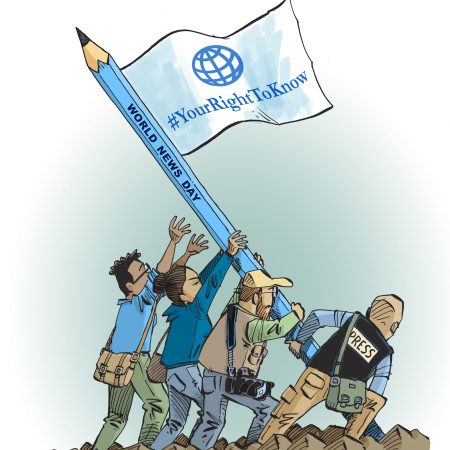
In a world overwhelmed by information, one of the greatest challenges facing society today is not simply finding news, but knowing what to trust. Every day, millions of people wake up to breaking news, social media posts, videos, photographs, political claims, rumours and competing narratives. Information travels across borders within seconds, but speed does not guarantee accuracy, and visibility does not guarantee truth. This is why World News Day, observed on 28 September, is so important. It is an opportunity to recognise the essential role of journalism in helping societies understand what is happening around them and to reaffirm a fundamental principle: people have a right to know.
Journalism is much more than reporting what happened. It is about asking why something happened, who is affected, what evidence exists, whose voices have been heard and whose voices may have been ignored. A headline may tell us that a conflict has erupted, but responsible journalism helps us understand the people caught in that conflict. A statistic may tell us that thousands have been displaced, but journalism can show what displacement means for a family that has lost its home, livelihood, education or sense of security. A government announcement may tell us what authorities claim, while independent journalism can examine the evidence, seek responses from affected communities and provide the wider context needed to understand the issue.
For millions of people living through conflict, displacement, humanitarian emergencies, political instability and environmental crises, access to reliable information can have real consequences. In fragile environments, rumours can spread faster than verified information, disinformation can deepen fear, and propaganda can manipulate public understanding. When journalists are prevented from asking questions or reporting freely, communities can lose one of their most important channels for making their experiences known. This is why trustworthy journalism is not a luxury reserved for peaceful societies. It is particularly important where information is restricted, contested or dangerous to obtain.
At World Crisis Watch, we believe that every crisis has a human story. Behind migration statistics are families searching for safety. Behind conflict figures are civilians trying to survive. Behind humanitarian assessments are people waiting for food, shelter, healthcare and dignity. Behind environmental statistics are communities confronting floods, drought, displacement and uncertainty. Behind every number is a person. Responsible journalism should not reduce people to numbers; it should provide context to their experiences while protecting their dignity, safety and privacy.
Journalists around the world continue to work under difficult circumstances. Some face censorship, intimidation, harassment, legal pressure, violence and economic insecurity, while others work in environments where even basic access to information is difficult. Yet journalism continues. Reporters document events, investigative journalists examine evidence, local journalists report from communities that international media may struggle to reach, researchers analyse data, editors verify information, and audiences question claims and demand accountability. World News Day provides an opportunity to recognise this ecosystem of public-interest information and to reaffirm that societies need credible mechanisms for discovering, checking and correcting facts.
The information environment is also being transformed by artificial intelligence and rapidly developing digital technologies. AI can help journalists analyse documents, translate material, identify patterns and process enormous amounts of information, but the same technologies can also make it easier to create convincing false content, manipulate images and videos, imitate voices and spread misinformation at unprecedented speed. In this changing environment, journalists and audiences must ask important questions: Who produced the information? What evidence supports it? Can the original source be verified? Has the information been confirmed independently? Has an image or video been taken out of context? Has the journalist clearly separated verified facts from allegations and opinions? These questions are becoming essential to responsible journalism and media literacy.
The right to access reliable information should not depend on geography, language, wealth or political power. People in conflict zones, refugee communities, fragile states and peaceful societies all deserve journalism that takes facts seriously and treats people with dignity. People should also be able to access information in languages they understand. For communities whose stories are rarely represented in international media, local-language journalism can be especially important because it connects global developments with local realities and ensures that communities are not merely subjects of reporting but active participants in the information ecosystem.
Trusted journalism does not mean journalism that simply tells people what they want to hear. It means journalism committed to evidence, verification, transparency and accountability. It means checking information before publication, giving people an opportunity to respond, distinguishing facts from allegations, protecting vulnerable sources, correcting mistakes and explaining uncertainty when evidence is incomplete. Trust is not created simply by a large audience, a respected name or a professional-looking platform. Trust is earned through consistent, responsible and ethical journalism.
At World Crisis Watch, we see World News Day as more than an annual celebration. It is a reminder of the responsibility that comes with publishing information. Our mission is to contribute to evidence-based journalism and research on conflict, security, humanitarian crises, migration, governance, peacebuilding, climate and other challenges affecting communities around the world. We believe journalism should bring facts closer to people, make complex crises understandable and provide space for voices that are too often overlooked. We also believe journalism must continue to evolve by combining reporting with research, verification, data, digital investigation, media literacy and the responsible use of technology. However, one principle should remain unchanged: the truth matters.
To journalists working in difficult places, World News Day is a reminder that your work matters. Keep asking questions, keep verifying, keep documenting and protect the people who trust you with their stories. A verified fact can challenge a false narrative. A carefully documented investigation can bring hidden realities into public view. A single credible report can help a community be heard. Journalism may sometimes appear small against the scale of a global crisis, but accurate reporting can have a lasting impact.
Readers also have an important role in protecting the information environment. Before sharing information, pause and check the source. Before believing a dramatic claim, look for evidence. Before judging an entire community based on a viral post, seek reliable and independent information. Read beyond headlines, ask questions and support journalism that demonstrates its commitment to facts and accountability. Being informed is not simply about consuming more information; it is about learning how to distinguish reliable information from misinformation, manipulation and unverified claims.
World News Day reminds us that reliable information is fundamental to an informed society. In an age of conflict, displacement, climate emergencies, political uncertainty, technological transformation and information overload, the need for trustworthy journalism is not disappearing—it is becoming more important. The world does not need more noise; it needs facts, context, accountability and journalism that listens to communities, investigates evidence and tells difficult stories responsibly.
On World News Day 2026, World Crisis Watch stands with journalists, researchers, editors, media organisations and communities working to protect the integrity of information. The right to know belongs to everyone. It is not a privilege reserved for the powerful, the wealthy or those living in peaceful societies. It is a fundamental part of an informed and accountable world.
Author: Naser Khan Zazai, Journalist and Researcher
Denied a Visa, Denied a Voice: The Cost of Restricting Journalists